Wednesday / October 14, 2026 @ 8:00 am - Saturday / October 17, 2026 @ 5:00 pm
Cross-Border Mobility: Migration, Logistics and Geopolitics – call for papers
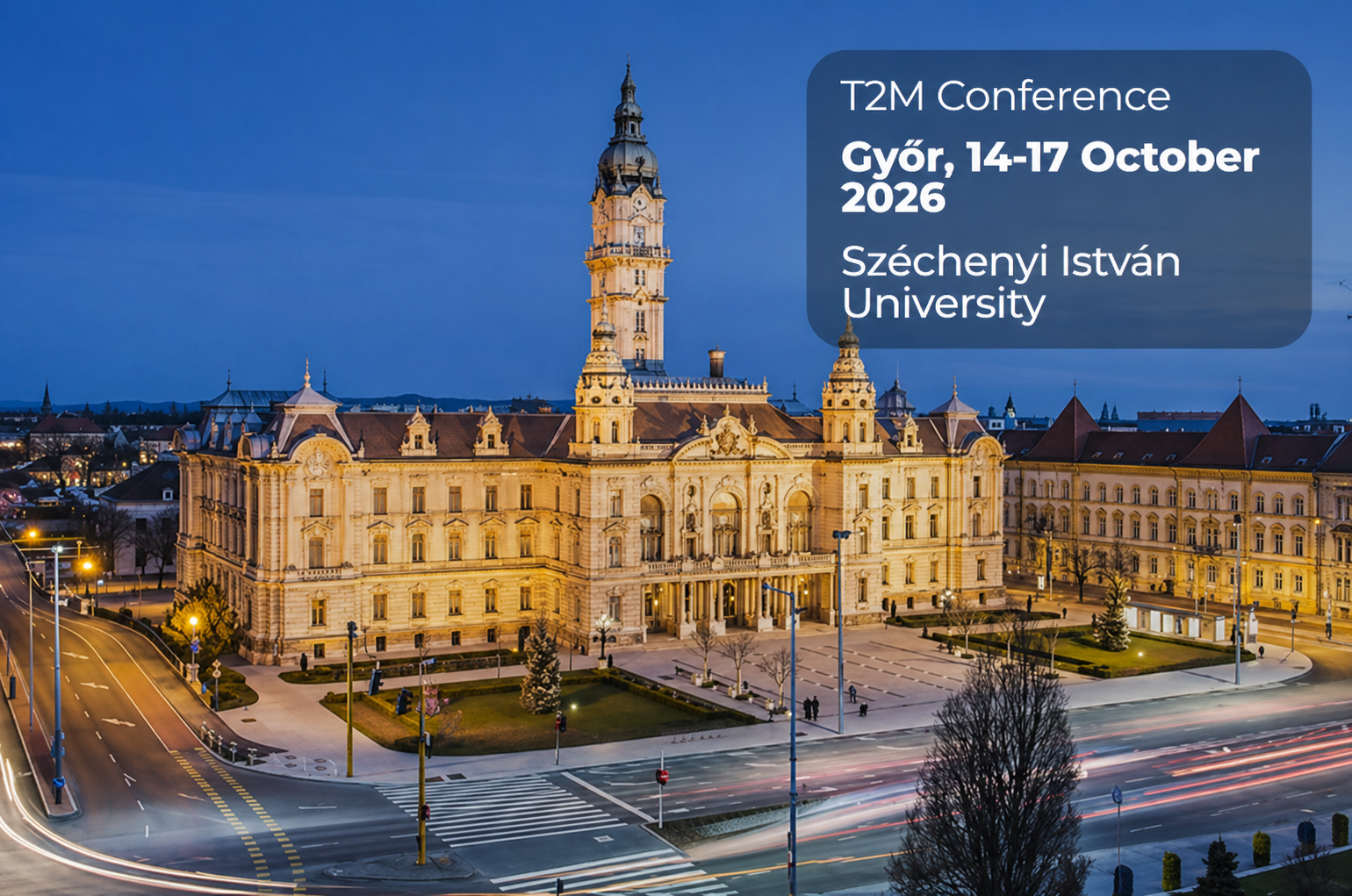
Győr, Hungary – October 14-17, 2026
The Széchenyi István University in Győr is pleased to invite you to Cross-Border Mobility: Migration, Logistics and Geopolitics of T2M the International Association for the History of Transport, Traffic and Mobility. The conference aims to provide an academic platform for researchers, professionals, policymakers, and stakeholders to present their work and research on the history of mobility and its contemporary human implications. By fostering collaboration and adopting multidimensional approaches, the conference seeks to identify pathways toward a more inclusive, resilient, and sustainable future mobility.
Submission Information
Authors are invited to submit abstracts or full papers for presentation at the conference. Selected papers may also be published in Scopus/WoS-indexed journals. The official language of the conference is English.
aim and scope
Following the First World War and the dissolution of the major empires, the imposition of rigid borders and systematic controls fundamentally restructured global transportation during the early twentieth century. This shift fragmented existing transport infrastructure as nations prioritised border sovereignty. Throughout the twentieth century, global shifts fundamentally reshaped cross-border mobility: international migration, trade, and logistics became deeply entangled with geopolitical interests, security, and economic strategy. Borders evolved from mere dividing lines into complex zones of regulation where state and non-state actors exert influence. Conversely, transport infrastructures often serve as a bridge; these cross-border systems facilitate cooperation and align the political and economic interests of neighbouring states. Within entities like the Soviet Union, the European Union, or the United States, these networks act as vital social, economic, and cultural arteries.
Cross-border mobility is a foundational force in human history. For centuries, the movement of people, resources, ideas, and power has shaped societal development, economic systems, and the spatial logic of states and empires. This conference seeks to examine these dimensions of mobility through both historical and contemporary lenses, focusing specifically on the intersection of migration, logistical infrastructure, and geopolitical strategy.
Mobility is more than mere physical movement; it is a social and political construct shaped by legal frameworks, technological capabilities, power dynamics, and cultural narratives. Analysing mobility allows researchers to cast new light on the evolution and current status of state borders and centre-periphery relations, revealing the specific mechanisms used to incentivise, restrict, or monitor human and material flow.
The conference emphasises that migration is never an isolated phenomenon; rather, it is deeply embedded within logistical and geopolitical contexts. The evolution of transport networks, trade routes, supply systems, and administrative structures has fundamentally dictated the direction, intensity, and social impact of human movement. Conversely, these migration patterns have actively reshaped geopolitical strategy, border enforcement, and the mechanisms of spatial control.
The conference is broad in its chronological scope: we invite proposals spanning the pre-modern, early modern, and modern eras, through to the twentieth and twenty-first centuries – a period defined by global conflicts and upheavals. We especially encourage contributions that adopt longitudinal approaches, theoretical proposals, comparative frameworks, or transnational perspectives.
This conference provides an interdisciplinary forum to examine the historical and contemporary dynamics of cross-border mobility. We invite contributions from historians, sociologists, humanities scholars, and international relations experts, as well as economists, legal scholars, engineers, and artists. We also welcome the perspectives of policymakers and educators. We particularly value presentations grounded in empirical research, comparative frameworks, or critical theoretical approaches that interrogate the nexus of migration, global logistics, and geopolitical strategy.
The conference welcomes submissions on a broad range of topics, including but not limited to:
- migration systems and population movements
- imperial, state and private logistics: the history, heritage, present and sustainability of roads, ports, railways, infrastructure, local transportation systems and warehouse networks
- the geopolitical significance of trade and transit routes
- military mobility, military supply and war logistics
- forced mobility: deportations, flight, resettlements, climate/environmental inequalities
- mobility, identity and border regions
- historical and current changes in geopolitical thinking and spatial perception
- socialist and post-socialist mobilities
- the relationship between mobility and state sovereignty
- the role of transport infrastructure in regional and cross-border integration
- global supply chains, logistics and infrastructure
- the impact of geopolitical conflicts and crises on mobility
- legal, economic, architectural and artistic aspects of cross-border mobility
- digitalisation, technology and new forms of mobility
Deadline for the submission of abstracts 7 June
Registration opens 1 June
Conference site: https://t2m2026.sze.hu

